Loading…
K6-2
Launched in 1998The AMD K6-2 is an enhanced evolution of the K6 introduced in 1998 for the Super Socket 7 platform, retaining the same basic superscalar, out-of-order Socket 7-derived core while adding support for AMD’s 3DNow! SIMD instruction set to improve floating-point and multimedia performance in games and graphics workloads. Manufactured on a 0.25 µm process, the K6-2 preserved the 64 KiB split L1 cache and efficient x86-to-RISC-like internal translation of the original K6, but paired it with higher front-side bus support, typically up to 100 MHz, which gave Super Socket 7 systems better memory and platform bandwidth than standard Socket 7 designs. Although its floating-point unit remained weaker than Intel’s Pentium II on a pure per-clock basis, the K6-2 offered strong value and broad compatibility, making it one of AMD’s most commercially important late-1990s desktop processors. Technically, it is best understood as the mainstream, 3DNow!-enabled refinement of the K6 architecture.
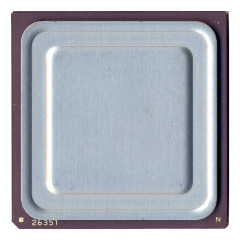 Blank K6-2
3 pictures
Blank K6-2
3 pictures
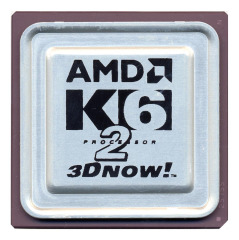 K6-2 Market. Sample
3 pictures
K6-2 Market. Sample
3 pictures
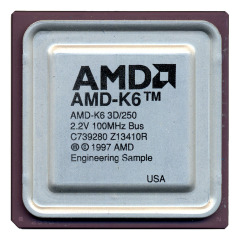 K6 3D 250 MHz ES
3 pictures
K6 3D 250 MHz ES
3 pictures
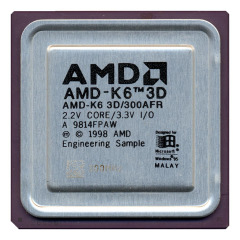 K6 3D 300 MHz ES
3 pictures
K6 3D 300 MHz ES
3 pictures
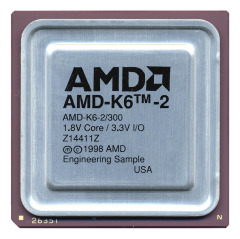 K6-2 300 MHz ES
3 pictures
K6-2 300 MHz ES
3 pictures
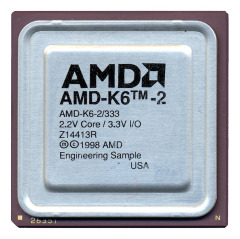 K6-2 333 MHz ES
3 pictures
K6-2 333 MHz ES
3 pictures
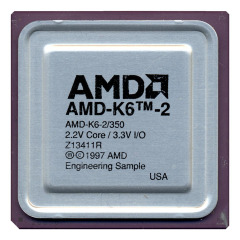 K6-2 350 MHz ES
3 pictures
K6-2 350 MHz ES
3 pictures
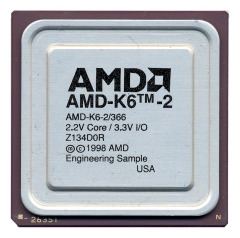 K6-2 366 MHz ES
3 pictures
K6-2 366 MHz ES
3 pictures
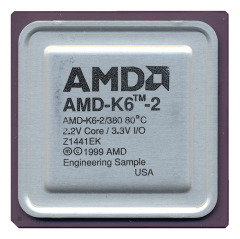 K6-2 380 MHz ES
3 pictures
K6-2 380 MHz ES
3 pictures
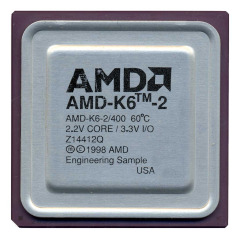 K6-2 400 MHz ES
9 pictures
K6-2 400 MHz ES
9 pictures
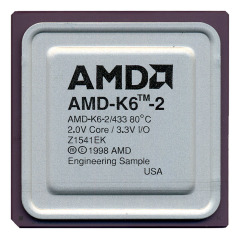 K6-2 433 MHz ES
3 pictures
K6-2 433 MHz ES
3 pictures
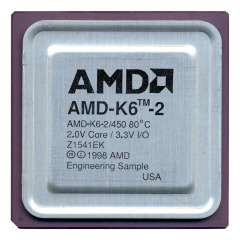 K6-2 450 MHz ES
3 pictures
K6-2 450 MHz ES
3 pictures
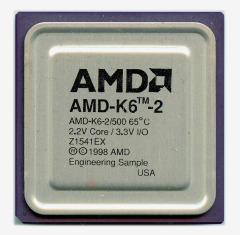 K6-2 500 MHz ES
3 pictures
K6-2 500 MHz ES
3 pictures
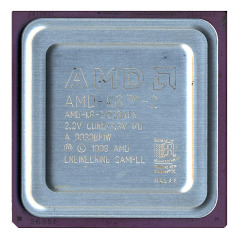 K6-2 533 MHz ES
3 pictures
K6-2 533 MHz ES
3 pictures
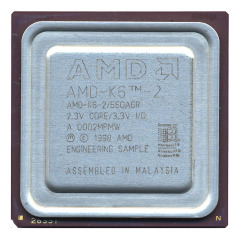 K6-2 550 MHz ES
3 pictures
K6-2 550 MHz ES
3 pictures